[Editor’s note]
At present, the society in China is undergoing a rapid transformation, and it has entered a period of "prominent contradictions" and "high risk". Risk is a prominent feature of this period, which has actually penetrated into all classes and people, including officials, especially those who are involved in land, houses, mines and local party and government leaders.
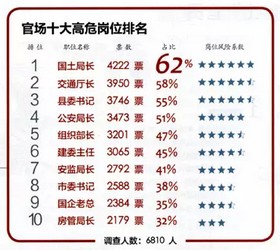
Is it a false proposition that officials are at high risk? According to the survey results of People’s Forum magazine, 44% of the respondents agree that "being an official is a high-risk occupation" and think that the top ten high-risk positions in officialdom are land director, transportation director, county party secretary, public security director, organization minister, construction committee director, safety supervision director, municipal party committee secretary, state-owned enterprise boss and housing management director. The specific investigation contents are as follows:
These posts can be described as "high-ranking" and serve the people well. What kind of official and social ecology is reflected behind their becoming high-risk posts?
What are the outstanding characteristics of the high risk of officials that are different from other groups? What is the deep reason behind it? How should we strengthen the relevant system construction, so that the key positions of government departments are no longer "high-risk"?
I. Director of Land and Resources
"Land-related" Officials under Hidden Rules
Post risk coefficient: six stars
Risk point: From planning and pricing to approval and supervision, power and risk are closely linked.
1. Hidden rules prevail, and it is difficult to be immune;
2. Fierce competition and strong public relations force;
3. The supervision system is not perfect.
According to the survey results of People’s Forum magazine, 62% of the respondents believe that the "land director" has the highest risk and ranks first. (Note: The risk coefficient is based on the percentage of people selected for this position, and the percentage is rounded to the nearest single digit, which is expressed in the form of star rating. If 62% of the respondents choose the director of land and resources, the risk coefficient is 6 stars. )
Too much power! Before the unspoken rules, the land directors have fallen.
"Why is everyone called’ land acquisition’ instead of’ land acquisition’? This shows that there are doorways. The conditions for’ land acquisition’ can be set by the government, and the planning government can change it. All competent departments have the final say." The chairman of a real estate company in Wenzhou said this when interviewed by the media. He even bluntly said that the operation of the land market basically goes ahead of the hidden rules.
On July 4, 2014, Li Junfu, director of Guangzhou Municipal Bureau of Land Resources and Housing Management and secretary of the Party Committee, was suspected of serious violation of discipline and accepted an organization investigation. Li Junfu was investigated for violating discipline, which once again exposed the loopholes in the land transaction supervision system. Many political and business people in Guangdong said that they were not surprised by Li Junfu’s accident. A real estate developer bluntly said: "Li Junfu is the god of wealth in Guangzhou, and he is in charge of important positions such as land storage, allocation of affordable housing, land transfer and real estate regulation and control, and his power is too great."
Power is great, supervision is not in place, hidden rules prevail, and bribery is rampant, making the land department the hardest hit area for corruption cases. Not only that, because the interests involved are complicated, there are many cases and cases in this field from time to time.
In 2009, five people were sentenced in Haikou planning land system. Among them, the former deputy director of Haikou Planning Bureau took bribes of 1.3 million yuan and was sentenced to 11 years in prison. The other sentenced officials were the former chief planner of Haikou Planning Bureau, the former chief of the land use department of Haikou Land and Resources Bureau and the former deputy director of the Treasury Payment Bureau of Haikou Finance Bureau.
In 2008, a case of land corruption was exposed in Zengcheng, Guangdong Province. The staff of the land department colluded with private entrepreneurs to defraud the state of idle land compensation funds as high as 145 million yuan, and nine officials fell in this corruption case.
A little earlier, during 2007-2008, the case of land subsidence in Chongqing shocked the whole country, including Tang Wenfeng, former director of Chongqing Development Zone Management Committee, Liang Xiaoqi, former deputy director of Municipal Planning Bureau, Huang Yun, director of Jiulongpo District Planning Bureau, Jiang Yong, former deputy director of Chongqing Land and Real Estate Bureau, etc. Nearly 10 departmental cadres were dismissed for accepting bribes from developers.
Hidden Rules-Latency, Violation and Rule
There are many "tricky things" in real estate from land transfer to planning adjustment, which is already a self-evident "secret" in this field. Land officials waved the power stick in their hands and acted as "hidden rules" under the cover of "explicit rules" in order to seek personal gain and corruption, which made the crimes in the land system appear to be latent, illegal and covered up by law.
Take the "bidding, auction and hanging" of land transfer as an example. Under the unspoken rules, government officials can resell the land to the intended buyers in various illegal ways according to the procedures of bidding, auction and hanging. The specific methods are as follows:
First, limit the qualifications of developers and shut out a large number of developers from the beginning;
Second, when auctioning land, additional conditions are set, such as the requirement to reach an agreement with the demolished person within 5 days, but these conditions may have been notified to the intended buyers long ago, and they began to prepare early, while other bidders may have to retreat because they don’t know;
Third, the time difference, such as the day before the holiday, requires bidders to pay the deposit within 3 days after listing, deliberately crowding out foreign competitors;
Fourth, what’s more, the default developer won the land with unusually high funds when bidding, but in the actual transaction, the government returned the high funds to the developer through some policies, and the actual transaction price of the land was the price agreed by both parties in advance. Therefore, the program of "bidding, patting and hanging" seems to have gone, but it is actually the same as not going.
It is easier to adjust the planning and floor area ratio, as long as the main leaders are fixed. Because the planning department has the final say in adjusting the planning, and the process of planning adjustment is closed, lacking publicity, hearing and other procedures. According to the public prosecution materials, in the case of land corruption in Chongqing, Liang Xiaoqi, former deputy director of chongqing urban planning bureau, committed illegal acts, including helping developers to adjust the plot ratio and adjust the nature and use of land.
Liang Xiaoqi’s case fully revealed that China’s land management departments have great power, but there are many loopholes and weak links in power norms and supervision mechanisms, and the decision-making, trial and supervision of land are not transparent and open enough, which is also the reason for the prevalence of hidden rules.
Eradicate hidden rules and scientifically evaluate land benefits
How to control land corruption? People naturally point the finger at power, and think that the key to control corruption is to improve the system and mechanism, strengthen the checks and balances of power and supervision, and increase the transparency of decision-making, examination and approval.
However, the interests in the field of land are huge. If what really happens under the appearance of checks and balances is the alliance of power and money, that is, it seems that it is actually a "hidden rule" according to the "explicit rules", and the law will be a dead letter. Without a scientific land revenue evaluation system and empty talk about power supervision, it is a tree without roots. Unspoken rules remind us that we need to put more energy into the evaluation of land benefits, introduce scientific evaluation system, control flexible benefits and gray benefits, and narrow the space of power rent-seeking, so as to truly minimize post risks.
Official testimony
"With the gradual increase in contact with developers, in the communication activities with some big money, my thoughts have changed color and I envy the lifestyle of being intoxicated. There is a serious misunderstanding of the purpose, meaning and realization of one’s own value in life. He thinks that the market economy is the capital economy, and only when you have money can you have everything, and you have the right not to expire. Deviations in ideological understanding have led to bigger mistakes. " -Du Jianping, former deputy director of Huai ‘an Land and Resources Bureau of Jiangsu Province
Second, the director of transportation
What is the crux of "high-speed" corruption
Post risk coefficient: five and a half stars
Risk point: the degree of marketization of China’s highway construction system is far from enough.
1. Being both the Chief Executive and the business leader;
2. The project is profitable and rent-seeking is simple;
3. monopoly of power and lack of supervision;
4. lax management and imperfect mechanism.
In recent years, the incident of the director of transportation falling off the horse is not uncommon, and the problem of "traffic corruption" is becoming more and more serious. According to incomplete statistics, in the past 20 years, there have been 16 officials who have served as local transportation directors (full-time), and if deputy directors are counted, this number exceeds 30. Among them, in Henan Province, Zeng Jincheng, Zhang Kuntong, Shi Faliang and Dong Yongan were successively dismissed, and in Shanxi Province, Wang Xiaolin and Duan Jianguo were successively dismissed. The corruption of officials of the Communications Department can be described as "wave upon wave".
On December 28th, 2009, Lei Jianmin, the former director of Linwei District Transportation Bureau in Weinan City, Shaanxi Province, was sentenced to life imprisonment and deprived of political rights for life by the Weinan Intermediate People’s Court for committing the crimes of corruption, bribery and huge amount of unidentified property. In the trial court, Lei Jianmin regretted it. "I finally fell on the’ corruption road’ laid by myself!"
The above cases are only part of the corrupt traffic director, which is why public opinion calls the traffic director a "high-risk group". According to the survey results of People’s Forum Magazine, 58% of the respondents agree that the post risk of traffic director is high, ranking second.
In order to put an end to the black hole in the traffic system, the central and local governments have promulgated relevant laws, regulations, systems and measures, and strengthened the anti-corruption efforts. However, the problem is that while laws and policies are constantly being promulgated, corruption cases are instead "wildfire never quite consumes them, they are tall once more in the spring wind". The director of transportation has "rotted in the past" and the traffic cadres have "collapsed" in a large area, which reflects that there are indeed loopholes in the system behind traffic construction. The key point is that at present, China’s highway construction is in an absolute monopoly position, which is directly operated by government officials, making it possible for them to seek rent through monopoly. Specifically, its institutional defects mainly include the following three points:
First, China’s current transportation investment system operates in a closed way within the transportation system. Almost all of a transportation construction project, from project demonstration, bidding design, construction supervision, budget allocation to completion acceptance, is exclusively responsible or led by the Communications Department. In this way, the disadvantages of investment, construction, management and use of the "four in one" and the separation of government and enterprise make the person in charge of the relevant department both the chief executive and the enterprise leader in the construction project; Being a builder and a manager, it is easy to make construction projects lack mutual restriction and supervision.
Second, power is a double-edged sword, which can not only benefit the people, but also be inherently corrosive and expansive. In order to prevent the abuse of power, it is necessary to use power to restrict power and establish the necessary supervision and restriction mechanism. However, the management power of the traffic management department is too centralized, which can easily lead to the abuse of power by the director of the department (bureau) who monopolizes the power and seeks personal gain for himself.
Third, the project investment system and the organizational form of traffic construction. The form of highway construction headquarters in China is the product of planned economy system, and its internal management is lax. In addition, the relationship between the traffic administrative department and the company responsible for highway construction is mostly mother-child, which leads to the departmentalization of government power, the individualization of departmental power and the absolutization of personal power, which is the source of corruption in the traffic system.
Third, the county party secretary
The Achilles heel of the county party secretary.
Post risk coefficient: five and a half stars
As the "top leader" of the county, the county party secretary holds a large part of power.
1. Different powers and responsibilities make it difficult to perform their duties;
2. Maintaining stability and testing ability;
3. The status is outstanding, and corruption is hard to prevent.
County officials have been "people-friendly officials" since ancient times, and they are the bridge between the party, the government and the people. The county party secretary, as the "top leader" of the county, is an extremely important position. According to the survey results of People’s Forum Magazine, 55% of the respondents agree that the post risk of county party secretary is high, ranking fourth.
The supervision weakness of the "number one"
How powerful is the county party secretary? In fact, the political, economic and social development of the county is relatively independent, and the county party secretary can have the final say on anything and anyone in the county; By the way, the county party secretary can stick his finger in the end, that is to say, he can catch big things and small things.
The "interest temptation" faced by the county party secretary is also great. The "projects" such as urban demolition and restructuring of small and medium-sized state-owned enterprises at the county level are often "major projects" involving hundreds of thousands, millions, tens of millions or even hundreds of millions of yuan. These projects often require the "final decision" of those county party secretaries with real power, and the "interest temptation" is a test for ordinary leading cadres.
The county party Committee is not the grassroots, but it is close to the grassroots; Not on the front line, but face the front line. The secretary of the county party Committee, the party in charge, is in danger of "one careless move will lose the game" However, at present, there is no set of effective methods for the selection, management and supervision of the county party secretary, which often leads to the fact that the county party secretary has too much power and lacks real supervision, and there are problems such as "the supervision at the higher level is too far, the supervision at the same level is too soft, and the supervision at the lower level is too difficult".
Because no one can really supervise the county party secretary, this kind of power is most prone to corruption. Some of them are rich by selling officials and titles, some are corrupt and bribery, and some are bent on being big officials to do their own things without dereliction of duty, indifferent to the interests of the masses, or even insensitive.
Looking at the whole country, news of corruption of county party Committee secretaries has occurred from time to time. In Anhui, in the northern Anhui area with Fuyang as the center, 18 county party secretaries have been investigated and punished for corruption. In the past four years, Henan has investigated and dealt with 22 county party Committee secretaries for corruption and bribery. The most typical case is Long Guohua, the former county party secretary of Zhuzhou. Less than ten days after CPC Central Commission for Discipline Inspection and the Central Organization Department jointly issued the Opinions on Further Improving the Credibility of Selecting and Employing People, Long Guohua unexpectedly made a case against the wind and suddenly promoted and adjusted more than 100 leading cadres, becoming the first "unlucky" county party secretary who fell before the central "killing order".
With too much power and lack of supervision, it is not surprising that "county party secretary" has become one of the typical high-risk positions.
The county party secretary has become the "local tyrant" in the county, and it is difficult to find the power to effectively restrict him within his jurisdiction. Under such a system, the degeneration of the "number one" will directly lead to the deterioration of the regional political ecosystem.
Is it really "the mountain is high and the emperor is far away"
Generally speaking, the county level far away from the central city is often on the edge of political geography, which makes the asymmetry of power and responsibility and "a thousand lines above and a needle below" the biggest difficulty in the work of the county party secretary. Under the tax-sharing system, the unreasonable financial distribution and the lack of local financial resources also make these secretaries "a clever woman can’t cook without rice." County-level is a high-incidence area of sudden public events. How to ensure development and stability is a test for all county party secretaries. If it is not handled properly, the "Weng ‘an Incident" is a lesson from the past.
On the one hand, this "political geography edge" makes it difficult for the county party secretary to carry out his work, on the other hand, it makes the hidden rules of officialdom more popular.
The power of the county-level supervisor is too large, and cadres will regard this county as the personal world of the county party secretary. At best, they will hold an attitude of being irrelevant and hanging high; The bad ones take the initiative to participate in the hidden rules of buying and selling officials.
This phenomenon is particularly obvious in some poor areas, such as Chen Zhaofeng, the former county party secretary of Dingyuan, Anhui Province, and Lin Longfei, the former county party secretary of Zhouning, Fujian Province, who are "ten million county decrees", all of which are typical of the county party secretaries of poor counties who sell their officials and titles to get rich. Because they are located in poverty-stricken counties, there is no other way to "get rich" except selling officials. As long as the appointment and removal rights of cadres above several hundred department levels in a county are tightly held in the hands of the county party secretary, it is an inexhaustible wealth.
Du Zaixin, the former secretary of Jianli County Party Committee, mentioned in his repentance book that someone had reminded me that the former secretary of Jianli had "Eight donkey kong" magical powers and asked me to be careful not to repeat the same mistakes. And what about me? As soon as I arrived at Jianli, I was targeted by Dai, Hu, Su and others. The direction of the car was not where I wanted to go.
Facts show that in addition to strengthening the training and education of county party secretaries, we must further improve the mechanism, reform the system and innovate the system, strengthen the supervision and restriction on the county party secretary’s exercise of power, let the power run in the sun, and let ordinary people truly become the main force and fresh force of supervision, which will greatly make up for the institutional defects and luck of "the mountain is high and the emperor is far away".
Confessions of a county party secretary
Chen Zhaofeng, secretary of the former county party committee of Dingyuan, Anhui Province: I came to Dingyuan with a fiery heart and the idea of doing something. In 1990, I was elected as the deputy county magistrate. At that time, I was strict with myself, so I was indifferent to money. I often tell my family members what to do if some farmers, workers and needy households send some agricultural and sideline products and can’t refuse them? I will exchange alcohol and tobacco at home with him. I feel more balanced in this way.
Now it is a market economy society, and people pay attention to exchange. The word exchange was originally used in commodity trading, but with the development of society to the stage of market economy, the word exchange has far broken through the field of commodity trading, entered the political field, personnel field and ideological field, and even become an integral part or a factor of people’s world outlook. Nowadays, people pay attention to material benefits. For example, when you go to someone’s house, you just say "Thank you, old leader" and so on. After you leave, the old leader may not say anything, but his family or others will say that you are all lip-service, all empty-play, so will people still talk to you if you have sex twice? Of course not!
Therefore, one reason why I have come to this stage today is that the consciousness of value exchange has penetrated into my ideas. The second is to pay attention to benefits, and the word benefits has been more concrete by me. Chen Zhaofeng was hailed as the biggest greed in Anhui Province, with 110 official hats sold for 1.5 million yuan, and his horse fell in 2006. )
Fourth, the public security bureau chief
"White and Black" of Public Security Bureau Chief
Post risk coefficient: five stars
Risk point: Compared with other departments, public security organs have extensive powers, and their management and responsibilities cover both administrative law enforcement and criminal justice.
1. The social network is complex and full of temptations;
2. bloodshed and sacrifice, life is a matter of life;
3. Great pressure and danger;
4. Keep one’s word, weak supervision.
In recent years, the constant exposure of shady scenes has caused the image of some public security bureau chiefs to plummet in the hearts of the people.
On July 20th last year, CPC Central Commission for Discipline Inspection official website announced that Wu Changshun, vice chairman of Tianjin CPPCC and director of the municipal public security bureau, was under investigation for serious violation of discipline and law. According to insiders, Wu may be suspected of using patents to gain illegitimate interests in Tianjin’s transportation field. It is reported that Wu Changshun has been the director of traffic management for 11 years and the director of Tianjin Public Security Bureau for 11 years. The 34 patents he invented are related to intelligent transportation and other fields, and most of the companies that hold the patents have public security backgrounds, and their business scope also overlaps with their management fields. According to experts’ analysis, this operation mode is easy to exchange interests in the procurement process and the reward link for the patentee.
According to previous media reports, Wang Lijun, the former director of Chongqing Public Security Bureau, had invented as many as 150 patents.
In addition, Xiao Qiang, former director of Leiyang Public Security Bureau in Hunan Province, Li Ping, former director of Nanzhao Public Security Bureau in Henan Province, and Guo Liang, former deputy director of Datong Public Security Bureau in Shanxi Province … were dismissed one after another. According to the survey results of People’s Forum Magazine, 51% of the respondents agree that the post risk of public security bureau chief is high, ranking third.
If the resumes of these fallen police chiefs go back to ten years ago, many of them are "excellent policemen" and "star policemen", and some are even "star directors" and famous "directors who crack down on gangsters". Ironically, some public security bureau chiefs actually hit themselves when they fell. Seven years ago, Xiao Qiang, the star public security director of Leiyang, Hunan Province, was awarded the title of "Black Hero" and won numerous honors; Seven years later, he was swept by the black storm launched by himself and was jailed; On September 19th, 2000, Wen Qiang captured Zhang Jun, the number one gangster in China, and gained great fame. Ten years later, Wen Qiang put an end to his official career in the crackdown on gangsters in Chongqing.
Some people say that the public security bureau chief is walking on the edge of the dye vat, dealing with all kinds of criminal crimes, illegal acts, hooligans and triads every day, and easily falling into the dye vat. Although the police chief is a "white man", he is in charge of the "underworld". In this society where everyone needs what he wants, if he ignores the party discipline and state law and deviates from the correct values, public rights will be combined with the underworld to form a close community of interests, with extremely bad consequences. "Black boss" or directly pay "protection fee"; Or let the "umbrella" share dividends in its long-term entrenched industries and enterprises, and even directly become the boss behind the scenes. In this way, all kinds of unjust enrichment are continuously transported to the hands of "protective umbrellas" through the extortion of "black bosses". At the same time, the "umbrella" keeps them at large. Money and interests are like a magnet with strong magnetism. The public security bureau chief should always try his best to prevent being attracted and struggle between "black" and "white".
Why do these fallen police chiefs walk between "white and black"? Some people say that after becoming a director, the world is different, so simple living, who can’t bear the salary of civil servants, is out of balance in front of some "rich people".
In the administrative system of politics and law in China, most public security directors hold important positions, either the Standing Committee of the Municipal Party Committee (county party committee), the secretary of the Political and Legal Committee, or the deputy mayor (deputy county magistrate). If the public security bureau chief works part-time as the secretary of the Political and Legal Committee, the tentacles of power can also reach into the courts and procuratorates. Once the public security bureau chief deviates from the proper ruling idea and abuses his power, the harm is much greater than that of ordinary cadres.
V. Minister of Organization
The Dilemma of "Official among Officials"
Post risk coefficient: four and a half stars
Risk point: the minister of organization holds the most valued power in officialdom and is in the most sensitive position.
1. Subtle status and high sensitivity;
2. Inside and outside the officialdom, layers of pressure;
3. System defects are the biggest test.
In the eyes of many people, the organization minister is an "official in charge of officials" and an "official among officials". He can directly serve as the party secretary or administrative chief, and he can "order hundreds of officials, but dare not disobey them". The organization department holds the most important power to select and employ people, and it is in the position of "taking the lead and moving the whole body". According to the survey results of People’s Forum Magazine, 47% of the respondents agree that the post risk of organization minister is high, ranking fifth.
The strong attraction of organizational personnel rights
The greater the power, the more people pay attention to it, the more complicated the relationship needs to be handled, the more difficult the work is, and the more temptations it faces. Be responsible to the Party Committee and assist the secretary in selecting talents. Next, we should coordinate with the leaders of various departments, understand and master the basic situation of officials at all levels and departments, and provide reference for employment decision-making. Externally, the organization department is the department that has suffered the most "sugar-coated cannonball" attacks. It must not only resist the test from outside the public power system, but more importantly, it must face the intrusion of "running officials and wanting officials, buying officials and selling officials" within the system.
This kind of erosion is pervasive, and sometimes it is hard to resist. Under the attack of huge interests, sometimes even family ties, those who are not strong-willed will corrupt and corrupt, and those who are honest and clean will be disturbed. The former, like Han Guizhi, took advantage of his position to sell officials and titles. Since serving as the deputy director of the organization department, he has sought benefits for 63 people or their relatives in terms of job promotion and job adjustment in ten years, and exchanged power for money, and the amount of bribes reached more than 7 million yuan. The latter, like an "honest official" in the organization minister, has to be careful from time to time in his work and be wary of everything.
Several organization ministers working at the grassroots level interviewed by the author lamented that "the organization work is difficult to do, and the organization minister is not good." An organization minister even told reporters that he was afraid to go home during the Chinese New Year and hid in the classroom of the county middle school. An old friend wanted to see him, and he met him in a simple school building after being informed by his family. He said, "There are too many gift givers to send cards. I can’t stand it." This shows that it is difficult to be a good organization minister.
Choosing a poor cadre is dereliction of duty, and the bigger test is the invasion of corruption. A little carelessness may violate the national law. The public power system is a huge "magnetic field", and the right to organize personnel has the strongest attraction in this magnetic field. Those officials who have fallen into the whirlpool of this power are unable to extricate themselves and eventually lose their reputation. Han Guizhi, who served as member of the Standing Committee of Heilongjiang Provincial Committee of the Communist Party of China and Minister of Organization Department in 1996, was involved in the "biggest official selling case since New China" and was sentenced to death with a suspended sentence. Xu Guojian, who served as the organization minister of jiangsu provincial party committee and secretary of Yancheng Municipal Committee, accepted bribes of more than 6.4 million yuan, and his death was suspended. Duan Yihe, Director of Organization Department of Qihe County Committee in 1976, Director of Organization Department of Provincial Party Committee in 1990. In 1998, he was the organization minister of Jinan Municipal Committee. In July 2007, he made a shocking "Jinan car bombing" and killed his mistress. In September 2007, he was brought to justice. Once crowding round, once keeping one word, all became distant dreams at the moment of sentencing, and hot power turned into cold handcuffs at that moment. I’m afraid only the parties themselves know the taste.
An irresistible temptation
There are still loopholes in our current system, and violations of laws and regulations are sometimes hidden and difficult to investigate. But this one or two hand-reaching, is likely to become the beginning of corruption. There are many people who fail to grasp themselves in the position of organization minister and slide into the abyss of crime. The request of family members, the introduction of friends, and even luck make them embark on the evil road of helping others get promoted and collecting money for themselves.
A good system can bring up a group of good officials, and an imperfect system makes many good officials "exhausted" and many mediocre officials and corrupt officials "successful in official career". Sometimes our system regulations are good, but it is precisely the executors who "skew the classics" in the process of implementation that make the system idle. The appointment of a cadre generally goes through the following procedures: after a vacancy occurs in a certain position, it is nominated by "relevant parties" and then organized for assessment. However, in practice, these procedures are greatly simplified.
The case of Zhou Guangquan in Anhui is a typical example. As the secretary of the municipal party committee, the above organizational procedures were simplified to "those who buy officials send money-Zhou Guangquan instructed-the organization department inspected-Zhou Guangquan was appointed at the Standing Committee of the municipal party committee". Here, the organization department became the organ instructed by the executive secretary, and all the inspection procedures became a formality. Of course, the organization minister is to blame.
VI. Director of the Construction Committee
Post risk coefficient: four and a half stars
Risk point: The Project Construction Committee can manage all aspects of urban construction in every detail.
1. Work is directly related to people’s livelihood and interests are intertwined;
2. Professional standards are involved, and social supervision is weak;
3. The project has huge funds and abundant oil and water.
The work of the Construction Committee is related to people’s livelihood, and the interests of real estate development, demolition and resettlement, and bidding for infrastructure projects are complicated. A decision of the Construction Committee may lead to social stability problems. In order to escort the construction project, businessmen from all walks of life can use all kinds of sugar-coated shells on the officials of the Construction Committee. Whether they can resist the temptation is a big test for the director of the Construction Committee. Personal professional risk is directly proportional to power and temptation level.
Bi Chuanpu, the former director of dadukou district Construction Committee, said, "Being an official": The first step is to collect the boss’s "benefits" for many times, and he is more and more courageous. The second step is to collect the benefits and then lend them to the bribing boss. During the renovation of city street lamps in Dadukou, Bichuan Waterfall was taken care of by a company in the project contract, and the boss of the company gave Bichuan Waterfall a benefit fee of 140,000 yuan in five times.
VII. Director of Safety Supervision
Post risk coefficient: four stars
Risk point: It is no exaggeration to say that the director of safety supervision is "sitting on the crater all the time" and "there is no trivial matter in safety work".
1. Decentralized power, powerless;
2. Local protection, heavy pressure;
3. Corrupt profiteers are pervasive;
4. Safety accountability, sword hanging high.
According to the data of public opinion monitoring Analysis Center of Xinhuanet, from June 2012 to January 2013, in just half a year, 11 directors of work safety bureaus at all levels in provinces and cities were transferred or prosecuted or suspended for corruption, bribery or dereliction of duty.
Each level of safety supervision director bears more important responsibilities than other departments and affects more important interests than other departments. Safety production accidents have always been the focus of public opinion. "If there is a safety accident, the relevant officials must be held accountable, which is a respect for life and law."
The safety supervision system must face the pressures and challenges from many aspects at the same time. Although manubrium has been realized at present, there are still institutional and institutional problems, and it has to face the pressure of local protectionism all the time. The concentrated outbreak of long-term accumulated unsafe factors makes the director have to be afraid from time to time and walk on thin ice.
"I don’t know" the embarrassment of the director of safety supervision
On March 15th, 2010, a fire broke out in Dongxing Coal Industry Co., Ltd., xinmi city, Henan Province, killing 25 miners. The reporter found Wang Ruilin, then director of xinmi city Safety Supervision Bureau, at the scene of xinmi city mine disaster and asked him more than 10 questions about mine disaster. Most of them said "I don’t know".
VIII. Secretary of the Municipal Party Committee
Post risk coefficient: three and a half stars
Risk point: the city level between provinces and counties is the key layer connecting the preceding with the following, and it also shoulders the heavy responsibility of urban development and rural construction.
1. Connecting the preceding with the following, with dual responsibilities;
2. It is difficult to supervise the power of one party;
3. Career turning point, a critical period.
The secretary of the municipal party committee, as the "number one" in several or even a dozen districts and counties, some of whom also serve as members of the Standing Committee of the provincial party committee, is a powerful person, and there are no shortage of sycophants and speculators around him. In addition, these people have high status and great influence, which makes it more difficult to supervise them. In addition, when the secretary of the municipal party Committee takes office, he is generally about 50 years old, facing the "turning point of career". He will enter the ranks of senior cadres one step further and face the "career ceiling" when he stands still.
The fall of the "number one" brings an official "earthquake"
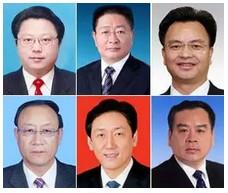
The anti-corruption storm after the 18th National Congress of the Communist Party of China has knocked down six incumbent party secretaries of provincial capitals, namely Mao Xiaobing in Xining, Wan Qingliang in Guangzhou, Zhang Tianxin in Kunming, Chen Chuanping in Taiyuan, Wang Min in Jinan and Yang Weize in Nanjing.
The first row from left: Yang Weize, Mao Xiaobing and Wan Qingliang.
The second row from left: Zhang Tianxin, Chen Chuanping and Wang Min.
In 2006, a case of collective corruption in Chenzhou officialdom led by Li Dalun, secretary of Chenzhou Municipal Party Committee, involved 158 party and government officials and business people. "In Chenzhou, Li Dalun has the final say." The Standing Committee of the Municipal Party Committee became his "centralized". In the later period of Li Dalun’s power, the selection of cadres was directly related to money. "The position promotion depends on the thickness of tickets".
Nine, the state-owned enterprise boss
Post risk coefficient: three and a half stars
Risk point: the unique position of being both an official and a businessman makes improper interests within reach.
1. Monopoly position and difficult supervision;
2. It is also official and business, close to the water tower;
3. Huge benefits are within reach;
4. Bribery traps are everywhere.
Li Yongzhong, an anti-corruption expert, believes that in more than two years after the 18th National Congress of the Communist Party of China, the main battlefield of anti-corruption began to break the stalemate. Although the situation is still severe and complicated, the internal corruption has begun to loosen, and the comparative advantage has been achieved. "It is urgent to open up the second battlefield of anti-corruption, that is, the anti-corruption in the hardest hit areas of state-owned enterprises and central enterprises."
According to statistics, after the 18th National Congress of the Communist Party of China, there were 74 senior executives of state-owned enterprises and state-owned companies. Except for 13 people whose level information was unknown, there were 60 senior executives at or above the departmental level. Among them, there are four vice-ministerial executives, namely Song Lin, former chairman and party secretary of China Resources Group, Wang Yongchun, former deputy general manager of China Petroleum Natural Gas Group, Li Hualin, former deputy general manager of China Petroleum Natural Gas Group and Sun Zhaoxue, former general manager of China Aluminum Company. Central enterprises based on special status and advantages have become the hardest hit areas of corruption in state-owned enterprises, with 36 people falling off the horse, accounting for almost half of the country.
On the one hand, it is the title of "red-top businessman" and its market position, on the other hand, it is a huge amount of bribes and a very high "imprisonment rate", which makes the boss of state-owned enterprises an enviable job and a high-risk position. "How much did the boss of state-owned enterprises take? How much should I get? " This is a controversial issue. The trap of bribery exists everywhere all the time, which is hard to prevent and fight.
If you can’t get "power", you can get "money"
Wang Shengjie, former chairman and general manager of the board of directors of Guangzhong Enterprise Group, said, "I always think it’s unfair. Those farmers’ contractors used to be illiterate, but later they all made a fortune doing this and that. We have worked in state-owned enterprises for a lifetime and worked hard for a long time. In the end, there is no more income. So I want to get some benefits by running a company and holding shares. "
X. Director of Housing Management
Post risk coefficient: Samsung
Risk point: As the last important supervision barrier set by the government for real estate management, the real estate management bureau has a great responsibility.
1. Due diligence will prevent real estate disputes, while dereliction of duty will indirectly create real estate disputes;
2. Due diligence will improve housing security, while dereliction of duty will condone speculation.
Choose the former or the latter in the face of responsibilities and interests? Before the interests of the people and businesses, forward or backward? These problems have become the vane of the professional risk of housing management director. He can choose to bring the "black-hearted" director to justice in the management of real estate surveying and mapping, or he can choose to collude with the director. Imperfect system, inadequate supervision, and lack of sense of responsibility and mission may lead them to the point of no return under the temptation of interests.
Zhou Jiugeng, the director of "sky-high smoke", encountered "human flesh search"
At the end of 2008, when house prices began to fall, Zhou Jiugeng, the director of the Housing Management Bureau of Jiangning District, Nanjing, made a statement to prevent developers from selling houses at low prices. As soon as this statement came out, Zhou Jiugeng became popular on the Internet. Some netizens pointed out through "human flesh search" that Zhou Jiugeng usually smokes 1,500 yuan a piece of "sky-high cigarettes" and wears more than 100,000 yuan a piece of famous watches … Under the overwhelming attack of online public opinion, the local Commission for Discipline Inspection launched an investigation into Zhou Jiugeng.
Wu Guangchun, member of the Standing Committee of the former Municipal Party Committee of Tongling City, Anhui Province, said: "I not only failed to manage myself well, but also failed to manage my family well. 90% of the money I received was transferred by my relatives and friends on behalf of my lover. These closest people sent me to court step by step."
(Source: People’s Forum, People’s Network, Xinhuanet, Zhongqing Daily, China Business News, compiled by People’s Forum reporter Wang Yufeng, original title: "Officialdom Ecology, which post has the highest risk factor? 》)